To walk a labyrinth is a form of meditation. One sets an intention at the entrance, at the start of the walk. Arriving at the center is a moment, a pause, a turn before retracing outward, with a different perspective, if even on the same path.
Intentions are different than attention, and attention spans are in short supply these days with short cycles and short circuits. However in the process of making this labyrinth, from chimney brick debris, my attention has continuously been drawn to the rubble and dust, how a brick can be hard and soft, material of the establishment, yet easily dissolvable. Bricks are pigmented from the earth their source, distinct from the cement and mortar that binds it. My attention reshapes into intention, a process of peace and renewal. A challenge: how to find peace and renewal amongst the rubble. How to persevere.
Rubble has a smell; dusty, dank, muddy. The feel is crumbly, soft and hard. It is unstable and unwieldily. These chimney bricks are manageable, 2" x 4" yet easily can cause the back to ache. Cinderblock and rebar housing srtuctures are far more dangerous. Both can be ankle twisting, back breaking, life threatening. The reclamation of the rubble is time consuming and painstaking, finding reusable forms, chipping off the mortar. The destruction of a chimney requires care and strategy, so as not to damage the house. The destruction of a cinderblock structure is often fueled by greed or hate or both. The destruction is rapid, near instant. The dust takes a while to settle, is suffocating and slow.
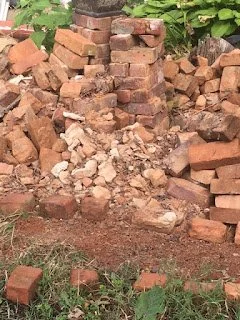
Rubble has a smell; dusty, dank, muddy. The feel is crumbly, soft and hard. It is unstable and unwieldily. These chimney bricks are manageable, 2" x 4" yet easily can cause the back to ache. Cinderblock and rebar housing structures are far more dangerous. Both can be ankle twisting, back breaking, life threatening. The reclamation of the rubble is time consuming and painstaking, finding reusable forms, chipping off the mortar. The destruction of a chimney requires care and strategy, so as not to damage the house. The destruction of a cinderblock structure is often fueled by greed or hate or both. The destruction is rapid, near instant. The dust takes a while to settle, is suffocating and slow.
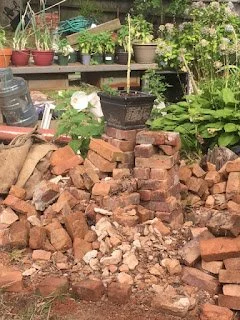
Nature will grow over the rubble, creating a blanket of green, hiding the life and death that lurks below. The accumulated weight of a stack of bricks can kill tree roots by their weight alone. The mass of brick or cinderblock is bone crushing, root crushing. Survival is a low percentage. What kind of peace and renewal is this? The red stain of brick, the dank smell of mud. A slow turn at the center.
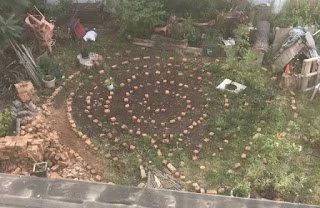
The bricks lay in piles for years, unused, raw, unsightly. Recently I created a simple 5 ring labyrinth, freehand. I sifted through the rubble, scaring spiders, waiting for something to pop out and scare me. Sifting, working around elderberry and asparagus obstacles, maintaining their positions, rather than relocating them, allowing them to be in their place, stepping on thyme, weeding out burdock and fennel and maple saplings. Walking the earth, connecting with roots, sending energy up in the hope that it can somehow, cosmically cause a shift towards peace and renewal.
There are those who destroy and those who create. The tri-cycle of Brama,Vishnu, Shiva comes to mind: creation, preservation-destruction. There is an inevitability in the dance and the sacredness of the destruction and renewal, and preservation. The term preservation stands out, in the middle of the creation/destruction tension. Preservation, conservation, repair- how do these fit into the dualistic mindset of the western Cartesian dichotomy?) I am angered by beachside cleanups because the people who volunteer to clean up are not the ones making the mess. The mess will not stop until the polluters and litterers do. Where is the preservation in this cycle of destruction and repair?