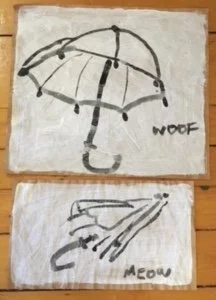
As I took down the brush and ink show, up in February and down mid July, it occured to me that these are the calisthenics of being an exhibiting artist.
The next task is to resume the excavation of the basement, full of possibility and treachery. The to take the accumulations of all-sorts-of-whatnot from decades of collecting and producing, and transform it into something that matters, that connects with you, dear viewer., is full of potential and possibility The treachery lies in the hoards and piles and stacks and collections; to not be consumed and drown in a tidal wave of cardboard and trinkets and molded plastic.
The neurotic distaste for disposing things can shift by aestheticizeing the act of relinquishing; to create something, to examine each object closely, to let it blur and abstract in the minds' eye, and then release the objects to the universe in the hopes that there are new homes to welcome these curbside pickups; A renewed functionality in someone else's life.
It's a process. Bring it all outside and only bring in what you need/want. Only touch something once.Give something away every time something new comes in. And so on.
On a lovely summer day I emerged from the basement to the curb with this small collection of stuff:
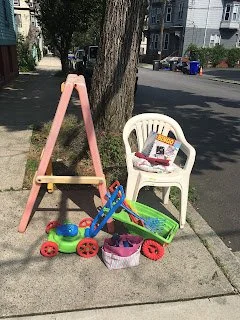
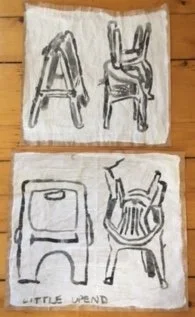
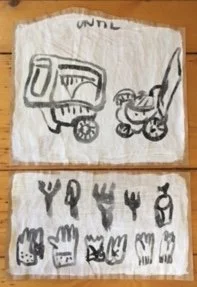
If you were a fly on the street corner in mid-July, you would have seen this pathetic and hilarious attempt, where I brought out a corners' worth of objects, felt a pang of regret and creativity and then sheepishly brought them back to my yard, with purpose. In a temporary outdoor drawing space I made a dozen or so ink-on-paper sketches. Then brought the real plastic items back out to the curb. By day's end they were gone! Amazing.
Many contemporary artists grapple with this crushing sense of the overwhelming amount of consumables, usually plastic, that get purchased and thrown away every day. It is popping up more and more and more in galleries and museums. The artist, taking twist ties and bread closures, plastic bags and buttons, straws and squashed cans, tire tensioners and video tape, turns it into something meaningful, a plea to the unheeding corporations to please stanch the flow of container ships full of disposable plastic arms and legs and baskets and bags and jewelry and fast fashion. It is a plea to slow the single use, disposable product manufacture way down. It is a commitment and an act of reckoning to to represent an accounting for the extraction for the sake of consumption. A monument, however small, to the transactions of material, supply, product and disposal.
There is a sub-genre of sculpture that is screaming to slow down the manufacture of the unnecessary; to please make it last and please make it at least biodegradable or don't make it at all, because the out of sight out of mind forgetting about it is no longer viable. This is another kind of dematerialization of art, or perhaps a decomposition of it. I'd like to insert myself into that practice.